 Download
 Download
![[thumbnail of fruity6small.png]](https://centaur.reading.ac.uk/28457/8/fruity6small.png "fruity6small.png")


Niyazi, H., Hall, J. P., O'Sullivan, K., Winter, G., Sorensen, T., Kelly, J. M. and Cardin, C. J.  ORCID: https://orcid.org/0000-0002-2556-9995
(2012)
Crystal structures of Λ-[Ru(phen)2dppz]2+ with oligonucleotides containing TA/TA and AT/AT steps show two intercalation modes.
Nature Chemistry, 4 (8).
pp. 612-628.
ISSN 1755-4330
doi: 10.1038/nchem.1397
ORCID: https://orcid.org/0000-0002-2556-9995
(2012)
Crystal structures of Λ-[Ru(phen)2dppz]2+ with oligonucleotides containing TA/TA and AT/AT steps show two intercalation modes.
Nature Chemistry, 4 (8).
pp. 612-628.
ISSN 1755-4330
doi: 10.1038/nchem.1397
Abstract/Summary
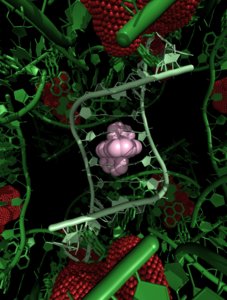
The ruthenium complex [Ru(phen)2(dppz)] (where phen is a phenanthroline and dppz a dipyridyl–phenazine ligand) is known as a ‘light switch’ complex because its luminescence in solution is significantly enhanced in the presence of DNA. This property is poised to serve in diagnostic and therapeutic applications, but its binding mode with DNA needs to be elucidated further. Here, we describe the crystal structures of the L enantiomer bound to two oligonucleotide duplexes. The dppz ligand intercalates symmetrically and perpendicularly from the minor groove of the d(CCGGTACCGG)2 duplex at the central TA/TA step, but not at the central AT/AT step of d(CCGGATCCGG)2. In both structures, however, a second ruthenium complex links the duplexes through the combination of a shallower angled intercalation into the C1C2/G9G10 step at the end of the duplex, and semi-intercalation into the G3G4 step of an adjacent duplex. The TA/TA specificity of the perpendicular intercalation arises from the packing of phenanthroline ligands against the adenosine residue.
Altmetric Badge
Dimensions Badge
| Additional Information | Cover picture of this issue of Nature Chemistry relates to this article. The editorial includes relevant comment and a link to it via doi.org/10.1038/nchem.1423 is provided in Related URLs. |
| Item Type | Article |
| URI | https://centaur.reading.ac.uk/id/eprint/28457 |
| Identification Number/DOI | 10.1038/nchem.1397 |
| Refereed | Yes |
| Divisions | Life Sciences > School of Chemistry, Food and Pharmacy > Department of Chemistry |
| Additional Information | Cover picture of this issue of Nature Chemistry relates to this article. The editorial includes relevant comment and a link to it via doi.org/10.1038/nchem.1423 is provided in Related URLs. |
| Publisher | Nature Publishing Group |
| Download/View statistics | View download statistics for this item |
Downloads
Downloads per month over past year
University Staff: Request a correction | Centaur Editors: Update this record